
How to Build an AI-Powered Ad Campaign With a Clear Funnel—and Track It to Revenue
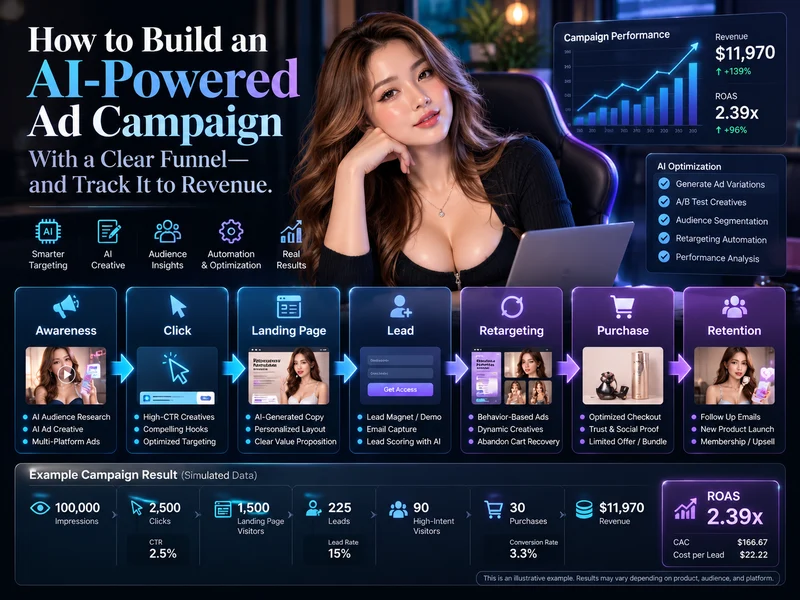
AI can make advertising faster, but speed alone does not make a campaign profitable. The real advantage appears when AI is connected to a clear funnel: one stage creates awareness, the next captures interest, the next turns visitors into leads, and the final stages convert and retain customers.
A useful AI marketing system should make it easy to answer one question at every stage: what should happen next? If the answer is unclear, the campaign usually becomes a collection of ads, tools, and dashboards without a reliable path to revenue.
Start with the funnel before choosing the AI tools
The campaign should be designed around the customer journey first. AI can then improve research, creative production, personalization, lead scoring, testing, and reporting inside that structure.
Where AI actually helps
AI is most useful when it removes repetitive work or improves the quality of decisions. It can summarize audience research, generate ad variations, help produce images or video concepts, rewrite landing-page sections, classify leads, identify weak funnel stages, and surface patterns in campaign data.
Google describes Performance Max as a goal-based campaign type that uses Google AI across bidding, audiences, creative combinations, and inventory such as Search, YouTube, Display, Discover, Gmail, and Maps. The important part is that the optimization is still tied to the conversion goals and signals you provide.
A complete campaign example, from ad spend to revenue
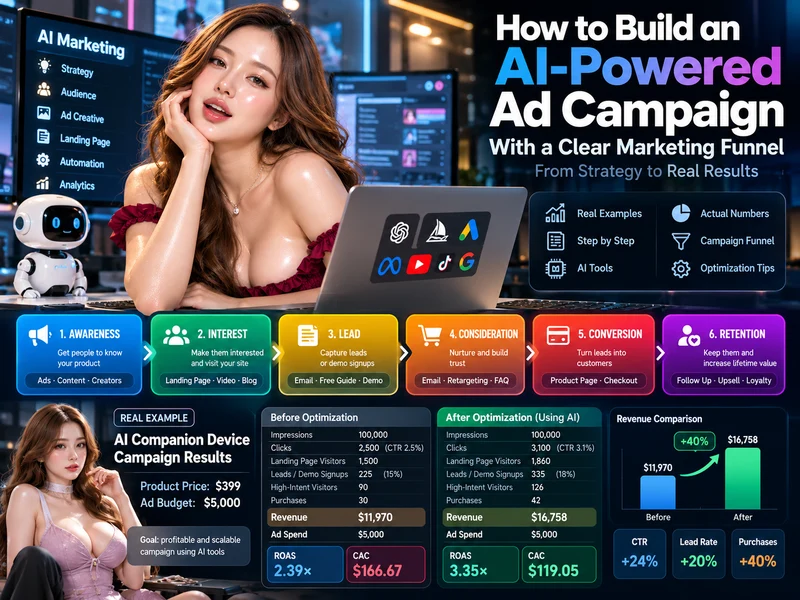
Here is an illustrative example for a premium AI companion device priced at $399. The numbers are simulated so the math is easy to follow; they are not a claim about a specific brand.
The revenue calculation is simple: 30 purchases × $399 = $11,970. With $5,000 in ad spend, the campaign produces a 2.39× ROAS. Customer acquisition cost is $5,000 ÷ 30 = $166.67, while cost per lead is $5,000 ÷ 225 = $22.22.
What the campaign looks like at each stage
Awareness: run short-form video, search, creator, and image ads around the strongest product problem or use case. AI can generate multiple hooks, headlines, storyboard ideas, and visual variations, but the core promise should stay consistent.
Interest: send each ad to a landing page that matches the promise in the creative. A technical ad should land on a technical explainer. A lifestyle ad should land on a page that explains the experience and use case rather than forcing every visitor into the same generic product page.
Lead: offer a demo, buyer's guide, waitlist, comparison checklist, product updates, or email incentive. AI can help score leads based on behavior, but a simple rule-based score can also work well when the data volume is small.
Consideration: use retargeting, email sequences, FAQs, testimonials, product comparisons, and objection handling. This is where many campaigns either build trust or lose the sale.
Conversion: remove unnecessary choices. Keep the price, product value, shipping, warranty, privacy information, and CTA easy to find.
Retention: follow up with onboarding, usage tips, accessories, upgrades, referrals, or membership offers. A campaign is stronger when the first purchase is not the only revenue event.
How AI can improve the numbers
Suppose the same $5,000 budget is kept, but testing improves the click-through rate to 3.1%, the lead rate to 18%, and the funnel produces 42 purchases. Revenue becomes $16,758.
That would move ROAS to about 3.35× and reduce CAC to about $119.05. This is an illustrative optimization scenario, not a guaranteed result. The purpose is to show why small improvements at several funnel stages can compound into a much larger change at the revenue stage.
Do not optimize for clicks when revenue is the goal
A high CTR can be useful, but it is not the final objective for most ecommerce campaigns. A creative can attract many clicks and still produce poor customers. The funnel should therefore be measured from impression all the way to purchase and, when possible, repeat value.
The most useful scorecard usually includes:
Real case study: scaling Performance Max without losing return
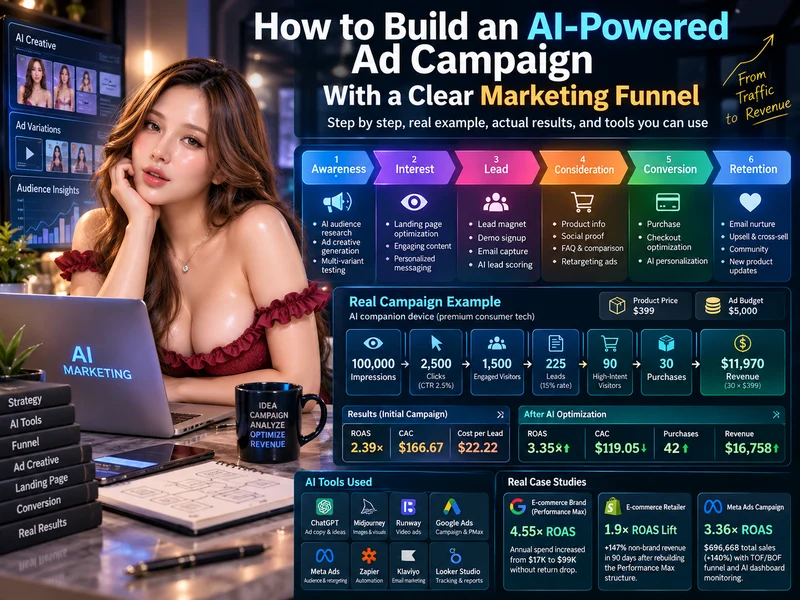
Actuate Media published a fashion ecommerce case study in which a designer accessories brand scaled annual Performance Max spend from about $17,462 in 2022 to $98,966 in 2025. The agency reported Performance Max ROAS improving from 3.67× at launch to 4.55× for 2026 year-to-date through September 4.
The case study also reported revenue up 13.5% year over year on 2.5% less spend for the January-to-September comparison window. One of the more useful details is that the team optimized toward actual purchase revenue rather than treating add-to-cart and other micro-conversions as revenue.
Real case study: separating top and bottom of funnel
A separate Meta Ads case study published by UNI Marketing reports $696,668 in Shopify total sales from June through November 2024, up 140% versus the previous six months. The agency reported average Meta purchase ROAS near 3.36× and bottom-of-funnel ROAS near 5.99×.
The structure matters more than the headline numbers: top-of-funnel campaigns were used for volume and learning, while bottom-of-funnel activity protected purchase efficiency. The setup also used first-party audiences, creative testing, GA4, enhanced conversions, and an AI dashboard that monitored ROAS, MER, frequency, and CPM.
The lesson from both cases
Neither case is simply “AI wrote the ads and sales went up.” The stronger pattern is more practical: clean tracking, clear conversion goals, better creative testing, disciplined funnel structure, and automation that receives useful signals.
This is why AI should sit inside the marketing system rather than replace the system.
A simple build order for a new campaign
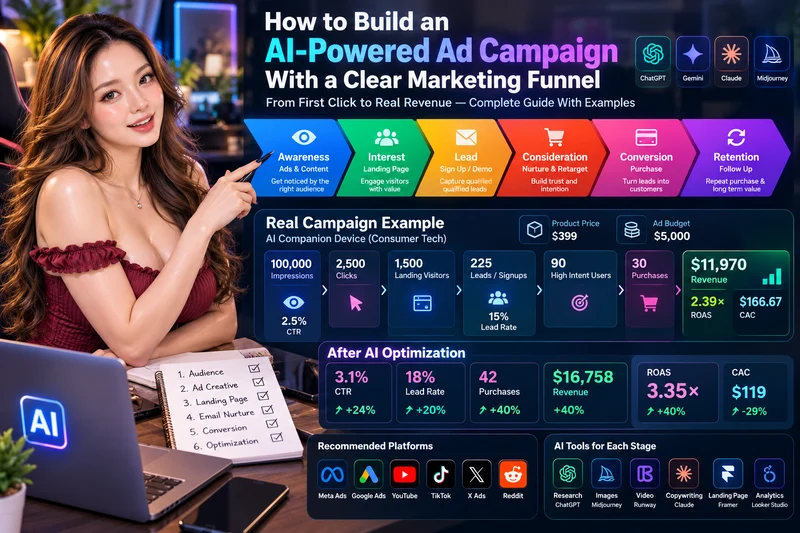
AI can personalize the funnel, but keep the message consistent
Personalization works best when it changes the presentation without changing the product truth. A visitor from a technical review can see deeper specifications. Someone from a lifestyle video can see use cases and visual proof. A returning visitor can see comparison content or a stronger conversion CTA.
What should not change is the core product promise, price logic, and claims. AI-generated variations still need review so the campaign does not invent features, guarantees, or testimonials.
For restricted categories, the funnel needs another layer
Some products face stricter ad-platform rules than ordinary consumer goods. Companion devices, dating products, health products, financial offers, and other sensitive categories may have limits on imagery, targeting, or claims.
In those cases, the awareness creative may need to focus on permitted themes such as technology, design, privacy, companionship, productivity, or general lifestyle benefits, while the owned landing page explains the product in more depth within applicable rules. Always check the current policy of the platform before launching.
Connect paid traffic with your own content
A strong funnel does not have to depend entirely on ads. Search articles, product comparisons, email, creator content, and educational landing pages can all become part of the consideration layer.
Mobzter has also covered how AI shopping agents could change online business and ecommerce, which is closely related to what happens when discovery, comparison, and purchase decisions become more automated.
The campaign should get clearer as customers move down the funnel
At the top, the message can be broad: a problem, idea, or compelling use case. By the middle, visitors should understand the product, the proof, and why it is different. At the bottom, the campaign should make the decision easy by removing uncertainty around price, trust, delivery, privacy, and the next action.
AI can make every stage faster to test and easier to analyze, but the funnel is what keeps those tools pointed at the same business outcome: turning attention into measurable revenue.

About MOBZTER

No comments
We’d love to hear your thoughts! Share your opinion, experience, or questions in the comments below and join the conversation with other readers. Your feedback not only helps us improve future articles, but it may also help someone else who is looking for the same information.