
How to Start Affiliate Marketing With Free AI Tools: From Sign-Up to Your First Commission
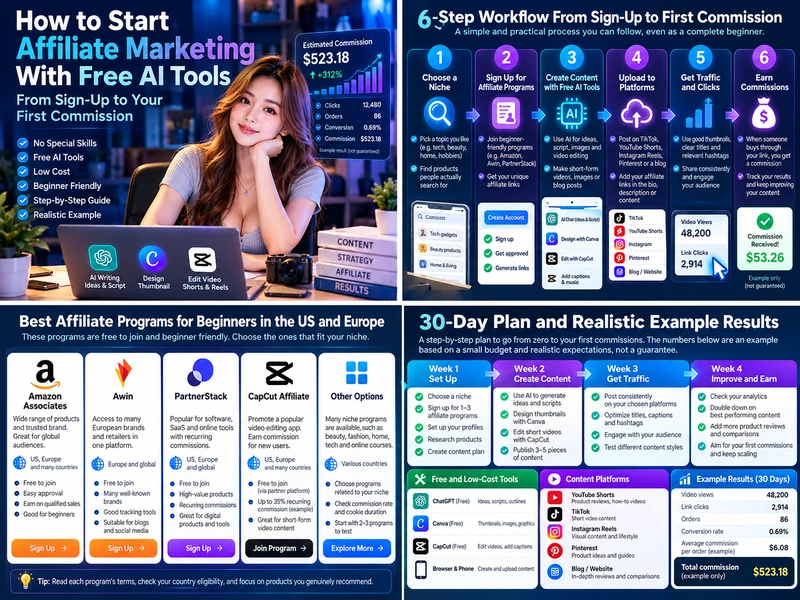
Affiliate marketing is one of the cheapest online business models to test because you do not need to manufacture a product, hold inventory, or handle shipping. You recommend products or software through a tracked link, and if someone completes an eligible purchase or signup, the affiliate program may pay you a commission.
Free AI tools can make the process much easier for beginners. They can help research products, draft scripts, turn long notes into short videos, create thumbnails, rewrite titles, and produce multiple content angles without hiring a writer or editor.
What you actually need to start
Beginner-friendly affiliate programs for the US and Europe
There is no single best program for everyone. The right starting point depends on your audience, niche, country, and the type of content you want to publish.
Do not join ten programs on day one. Pick one network and two or three offers that match the same audience. It is much easier to build content around a clear topic than to promote unrelated products every day.
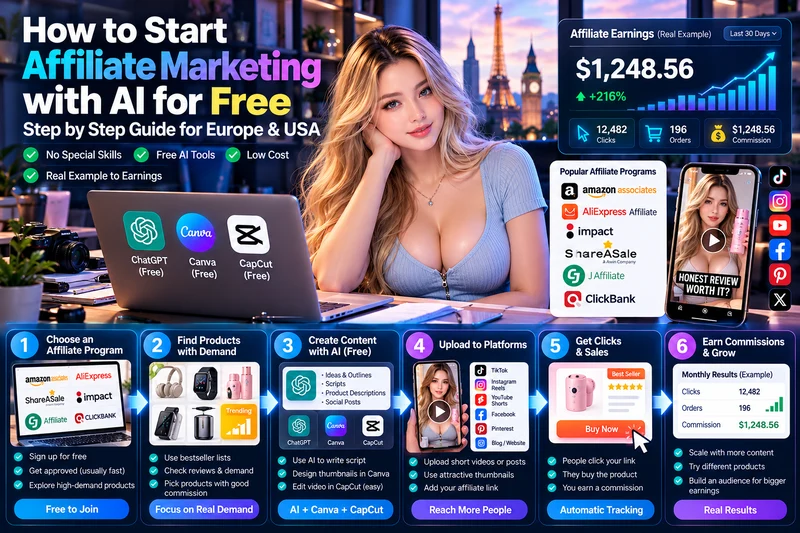
Step 1: choose a niche that gives you enough content ideas
A good niche is not just something with high commissions. It should give you enough questions, comparisons, reviews, tutorials, and product problems to create content for months.
For example, "technology" is too broad. "Budget desk gadgets for remote workers" is much easier. You can cover keyboards, webcams, charging docks, laptop stands, USB hubs, microphones, and productivity software without confusing the audience.
Step 2: pick products people are already trying to compare
Beginners often chase the highest commission percentage. That can be a mistake. A lower commission on a product people actively search for may be easier to monetize than a high commission on something nobody wants.
Look for products with clear use cases, visible customer demand, understandable pricing, enough reviews to research common complaints, and a reason to compare alternatives.
Step 3: use free AI to create the first batch of content
ChatGPT has a free tier, although some advanced tools have usage limits. For affiliate work, the most useful functions are brainstorming, summarizing specifications, creating comparison structures, rewriting hooks, and turning research into scripts.
Canva's free tools are enough for basic thumbnails, carousels, comparison graphics, and Pinterest images. CapCut also offers free online editing for cutting clips, adding text, rearranging scenes, and generating subtitles.
I am creating a 30-second affiliate video about [product].
Audience: [who it is for].
Use only the specifications I provide.
Write:
1. a 2-second hook,
2. the main problem,
3. three useful features,
4. one limitation,
5. a natural call to action.
Do not invent features or fake personal experience.
Prompt for comparison content:
Compare [Product A] and [Product B] using the data below.
Create a short script with:
- price,
- best use case,
- major strength,
- major weakness,
- who should choose each product.
If a fact is missing, say it is missing instead of guessing.
Step 4: publish where buying intent already exists
If you are starting from zero, two platforms are enough. For example, create one useful review, turn the key points into a short video, publish it on YouTube Shorts and TikTok, then write a longer comparison page when you have enough research.
Do not fake a review if you have not used the product
AI makes it very easy to produce convincing copy, which also makes it easy to cross the line into fake experience. If you have not personally tested a product, do not say "I used this for three months" or invent a result.
Use formats such as "what to know before buying," "features compared," "who this is for," or "specification breakdown." That keeps the content useful without pretending to have experience you do not have.
Affiliate disclosure is part of the content
In the United States, the FTC says affiliate relationships should be disclosed clearly and conspicuously near the recommendation or link. The FTC specifically warns that simply writing "affiliate link" may not always explain the relationship clearly enough.
EU consumer authorities also require commercial content to be identifiable. European Commission guidance recommends obvious wording and prominent placement rather than vague terms that consumers may not understand.
A realistic 30-day beginner plan
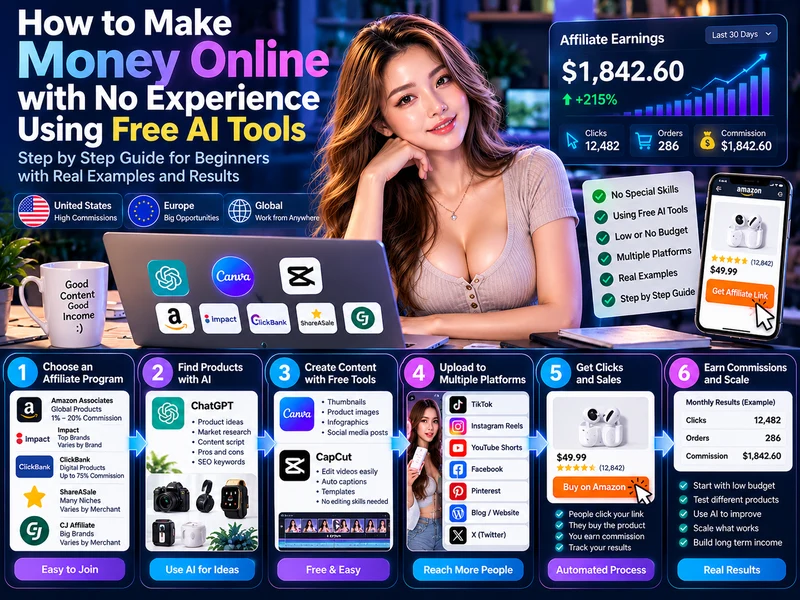
What might the first month actually look like?
Imagine you publish 20 short videos and five useful comparison posts. Most may receive little traffic. A few may perform noticeably better. That is normal: the first month is often more about finding a repeatable format than producing meaningful income.
Here is an illustrative example. Suppose your content generates 2,000 tracked affiliate clicks during the month. If 1.5% of those clicks produce 30 eligible conversions and your average approved commission is $7, the result would be $210.
That is not a forecast or typical-income claim. A beginner could earn $0, while another creator could earn much more. Commission rates, cookie windows, returns, cancellations, audience quality, and product price all affect the result.
The first useful milestone is not $1,000
A better first milestone is one piece of content that repeatedly produces clicks. If one review sends five qualified clicks every day, you have something measurable to improve.
Then test a better title, a stronger thumbnail, another product in the same category, or a deeper comparison. One repeatable content pattern is more valuable than a single lucky viral post.
How to turn one idea into five pieces of content
Suppose your topic is "best webcam for remote meetings."
AI can reshape the same research into each format. You still need to verify facts and make sure every version adds something useful instead of automatically publishing repetitive content.

Where beginners usually waste money
The biggest early mistake is buying too many tools before proving that the content can generate clicks. A paid AI subscription, premium editing app, expensive microphone, website theme, and keyword tool can easily turn a low-cost experiment into a monthly bill.
Start with the equipment you already own. Upgrade only when a specific bottleneck becomes obvious. If editing takes three hours per video, a better editor may be worth paying for. If nobody clicks, the problem is more likely the topic, offer, hook, or audience—not the subscription plan.
How to scale after the first commissions arrive
Once you know which content produces buying intent, build around the same audience instead of jumping to unrelated niches. Add closely related products, deeper comparisons, email capture where appropriate, and evergreen pages that can keep receiving search traffic.
If you later decide to use paid traffic, track the full funnel rather than clicks alone. Our guide to building an AI-powered ad campaign with a clear funnel explains how to connect traffic, leads, CAC, ROAS, and revenue.
For organic content, the same principle applies: useful content creates attention, the affiliate link captures intent, and the program dashboard tells you whether that traffic actually converts.
Keep the system small enough to repeat
A beginner does not need five websites, ten affiliate networks, and daily content on every social platform. One niche, a handful of relevant offers, one repeatable content format, and two publishing channels are enough to start learning.
Use AI to make the work faster, not to make the claims bigger. Verify product information, disclose the affiliate relationship, publish consistently, and let real click and conversion data decide what you create next.

About MOBZTER

No comments
We’d love to hear your thoughts! Share your opinion, experience, or questions in the comments below and join the conversation with other readers. Your feedback not only helps us improve future articles, but it may also help someone else who is looking for the same information.